

Sustainable car rentals help eco-conscious tourists explore Javea responsibly. Learn about green vehicle options, regulations, costs, and pitfalls to avoid.
Booking a car in Javea should not mean leaving your green values behind. Many eco-conscious travelers worry that transportation will undo the good they do at home. The rise of sustainable mobility means you no longer have to compromise between adventure and environmental responsibility. This guide reveals how to choose planet-friendly rental options, clarifies common misconceptions, and highlights the true value of green car hire for your Spanish getaway.
Table of Contents
- Understanding Sustainable Car Rentals And Misconceptions
- Types Of Eco-Friendly Rental Vehicles Available
- How Green Rental Processes And Standards Work
- Spain’s Legal Framework For Sustainable Mobility
- Environmental, Financial, And Practical Implications
- Common Pitfalls And Better Alternatives For Tourists
Key Takeaways
| Point | Details |
|---|---|
| Sustainable Car Rentals are Holistic | Sustainable car rentals focus on environmental, social, and economic factors, not just carbon emission reduction. |
| Variety of Eco-Friendly Vehicles | Options like Battery Electric Vehicles (BEVs) and Hybrid Electric Vehicles (HEVs) cater to environmentally conscious travelers. |
| Comprehensive Rental Processes | Rental companies are integrating environmental considerations into all aspects of their operations, enhancing their sustainability practices. |
| Legal Framework in Spain | Spain has established innovative laws promoting sustainable mobility as a national priority, supporting electric vehicle adoption and low-emission zones. |
Understanding Sustainable Car Rentals and Misconceptions
Sustainable car rentals represent a transformative approach to mobility that goes far beyond simply renting an electric vehicle. These services integrate environmental consciousness with practical transportation solutions, challenging traditional perceptions of car rental experiences.
Contrary to common misconceptions, sustainable car rentals are not just about reducing carbon emissions. Comprehensive mobility strategies demonstrate that sustainability encompasses social and economic dimensions as well. This holistic perspective means considering factors like:- Resource efficiency- Reduced environmental impact- Community transportation needs- Economic accessibility of mobility solutions- Long-term ecological considerationsSustainable mobility requires integrated approaches that balance technological innovation with responsible consumption. Car rental companies are increasingly recognizing that sustainability is not a single feature but a comprehensive strategy involving fleet management, customer education, and systemic thinking.
Car sharing mechanisms have emerged as powerful tools in this transformation. These solutions can dramatically reduce individual carbon footprints by optimizing vehicle usage, promoting shared transportation models, and introducing more fuel-efficient and electric vehicle options.
Moreover, sustainable car rentals challenge travelers to rethink their transportation choices. Instead of viewing car rentals as a simple transactional service, consumers are encouraged to see them as part of a broader commitment to environmental responsibility.
Pro tip: When booking a rental car, always inquire about the company’s sustainability practices and request the most fuel-efficient vehicle available for your trip.
Types of Eco-Friendly Rental Vehicles Available
The landscape of sustainable transportation has dramatically evolved, offering travelers in Spain an impressive array of eco-friendly rental vehicles that go beyond traditional transportation models. These innovative options provide environmentally conscious travelers with meaningful choices to reduce their carbon footprint while exploring the beautiful Spanish countryside.
Eco-friendly vehicle technologies have expanded to include several compelling options for responsible travelers. The primary types of green rental vehicles currently available include:
- Battery Electric Vehicles (BEVs): Zero direct emissions, 100% electric powertrain
- Hybrid Electric Vehicles (HEVs): Combine gasoline engine with electric motor
- Plug-in Hybrid Vehicles (PHEVs): Longer electric-only driving ranges
- Biofuel Vehicles: Utilize renewable plant-based fuel sources
- Hydrogen Fuel Cell Vehicles: Produce electricity through hydrogen chemical reactions
Advanced green vehicle classifications demonstrate that each vehicle type offers unique environmental advantages. Battery electric vehicles represent the most radical shift, eliminating tailpipe emissions entirely and providing a zero-carbon transportation solution for environmentally mindful travelers.
Moreover, these eco-friendly rental options are not just about reducing environmental impact. They represent a sophisticated approach to mobility that considers technological innovation, resource efficiency, and sustainable transportation infrastructure. Modern rental companies in Spain are increasingly integrating these green vehicle options to meet the growing demand from environmentally conscious travelers.

Here’s a quick comparison of eco-friendly rental vehicle options available to travelers in Spain:
| Vehicle Type | Environmental Impact | Typical Range |
|---|---|---|
| Battery Electric (BEV) | Zero tailpipe emissions | 150-350 miles |
| Hybrid Electric (HEV) | Lower emissions, uses fuel | 400-600 miles |
| Plug-in Hybrid (PHEV) | Electric range + fuel backup | 15-50 miles (electric), 350-600 (total) |
| Biofuel Vehicle | Renewable fuels, some CO2 | 300-500 miles |
| Hydrogen Fuel Cell | Water vapor emissions only | 200-370 miles |
Pro tip: When booking an eco-friendly rental vehicle, compare the actual carbon footprint and electric range of different vehicle types to make the most sustainable choice for your specific travel needs.
How Green Rental Processes and Standards Work
Sustainable car rental processes have evolved into sophisticated systems that go far beyond simple vehicle selection. These comprehensive approaches integrate environmental considerations into every aspect of the rental experience, transforming how travelers interact with transportation services in Spain.
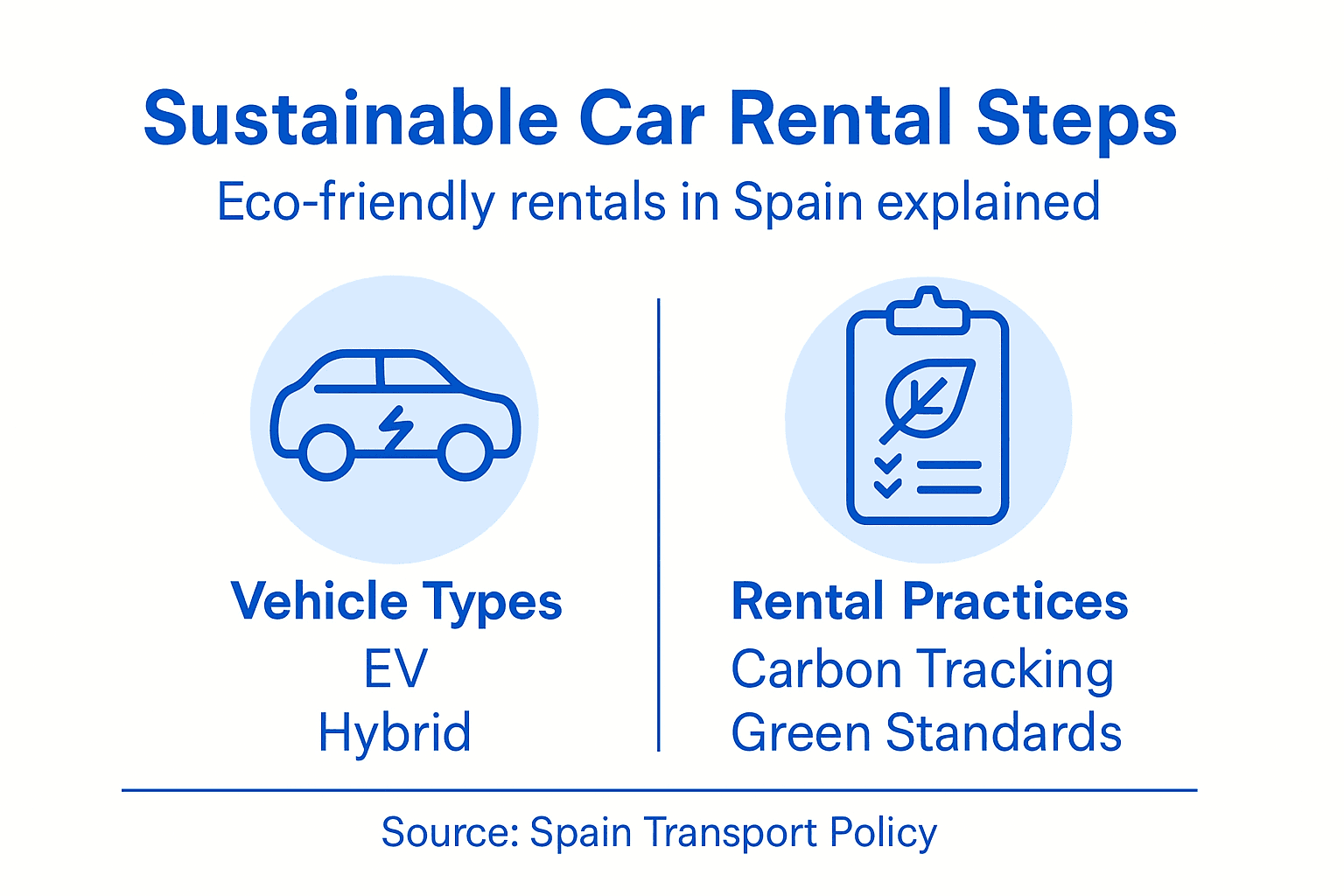
Green rental standards operate through multiple strategic mechanisms that ensure genuine environmental accountability. The key components of these green rental processes include:
- Fleet Management: Regular maintenance to maximize vehicle efficiency
- Carbon Tracking: Precise measurement of each vehicle’s environmental impact
- Emission Reporting: Transparent documentation of carbon output
- Sustainable Procurement: Selecting vehicles with lowest environmental footprint
- Energy Efficiency Protocols: Implementing systematic reduction strategies
Environmental performance frameworks demonstrate how rental companies integrate Environmental, Social, and Governance (ESG) principles into their operational models. These frameworks create accountability by establishing clear, measurable sustainability targets that go beyond traditional business metrics.
Modern green rental processes represent a holistic approach to sustainable mobility. They’re not just about reducing emissions, but about creating a comprehensive ecosystem that supports environmental responsibility, technological innovation, and consumer education. Car rental companies in Spain are increasingly viewing sustainability as a core business strategy rather than a peripheral concern.
Pro tip: Request a detailed sustainability report from your rental company to understand the specific green practices and carbon reduction strategies they employ.
Spain’s Legal Framework for Sustainable Mobility
Spain has emerged as a pioneering force in sustainable transportation legislation, creating a comprehensive legal framework that transforms how mobility services operate. The country’s approach goes beyond traditional regulatory measures, positioning sustainable transportation as a fundamental right and strategic national priority.
Sustainable Mobility Law introduces groundbreaking mandates that reshape transportation infrastructure. Key legislative provisions include:
- Workplace Mobility Plans: Mandatory sustainable transportation strategies for large employers
- Electrification Incentives: Financial support for electric vehicle adoption
- Low-Emission Zone Regulations: Strict urban access restrictions for high-emission vehicles
- Public Transport Enhancement: Increased funding and infrastructure development
- Fiscal Incentive Mechanisms: Tax benefits for sustainable transportation choices
Green Transportation Regulations demonstrate a holistic approach to environmental policy. The legal framework integrates national objectives with regional and municipal strategies, creating a unified sustainability ecosystem that encourages private sector participation and innovation.
These comprehensive regulations reflect Spain’s commitment to decarbonizing transportation and creating a more sustainable mobility landscape. By establishing clear guidelines, financial incentives, and enforcement mechanisms, the country is positioning itself as a global leader in sustainable transportation policy.
Pro tip: When renting a vehicle in Spain, always verify the vehicle’s environmental classification to ensure compliance with local mobility regulations.
Environmental, Financial, and Practical Implications
Sustainable car rentals represent a complex ecosystem where environmental responsibility intersects with financial strategy and practical considerations. Travelers and businesses alike are discovering that green mobility is no longer a peripheral option but a core strategic approach to transportation.
Sustainable rental practices reveal multiple interconnected benefits across different domains. The key implications include:
- Environmental Benefits: Reduced carbon emissions and resource consumption
- Financial Advantages: Lower total operational costs
- Brand Perception: Enhanced customer loyalty and market positioning
- Technological Innovation: Accelerated adoption of efficient vehicle technologies
- Regulatory Compliance: Meeting evolving legal sustainability requirements
Green Automotive Strategies demonstrate that sustainability can simultaneously drive environmental progress and economic performance. The practical challenges of transitioning to green vehicles include initial investment costs, charging infrastructure limitations, and fleet management complexity.
The transformation requires a strategic, phased approach that balances technological capabilities, financial constraints, and environmental objectives. Car rental companies must navigate these challenges by developing flexible, adaptive strategies that leverage emerging technologies and government incentives.
The table below summarizes how sustainable rental practices affect the environment, finances, and practicality:
| Impact Area | Key Benefit | Strategic Consideration |
|---|---|---|
| Environmental | Reduces carbon emissions | Requires clean energy sources |
| Financial | Lowers operating expenses | Initial investments higher |
| Practical | Enhances brand reputation | Needs infrastructure upgrades |
| Regulatory | Ensures legal compliance | Must follow local policies |
Pro tip: Research available government incentives and tax credits before investing in sustainable vehicle fleets to maximize financial returns and environmental impact.
Common Pitfalls and Better Alternatives for Tourists
Sustainable travel requires more than good intentions. Many well-meaning tourists inadvertently contribute to environmental and social challenges through uninformed choices that seem harmless at first glance.
Responsible Tourism Strategies reveal several critical pitfalls travelers must avoid. Key mistakes include:
- Overtourism Support: Visiting overcrowded destinations
- False Eco-Labeling: Trusting misleading environmental certifications
- Digital Footprint Neglect: Ignoring online environmental impacts
- Unsustainable Accommodation Choices: Selecting hotels with poor environmental practices
- Excessive Resource Consumption: Wasting water and energy while traveling
Sustainable Travel Alternatives emphasize the importance of choosing less-frequented destinations. Instead of contributing to environmental degradation in popular locations, travelers can make more responsible choices that support local ecosystems and communities.
Navigating sustainable tourism requires conscious decision-making and a willingness to challenge traditional travel patterns. By understanding the broader implications of our travel choices, we can transform tourism from a potential environmental burden into a force for positive change and cultural exchange.
Pro tip: Research and choose destinations that actively demonstrate commitment to sustainable tourism practices, and prioritize local, community-driven tourism experiences.
Choose Sustainable Mobility with Natalies Rent a Car in Spain
Traveling responsibly in Spain means making smart choices about your transportation. This article highlights the challenges travelers face when seeking eco-friendly car rentals such as understanding sustainable mobility concepts and navigating Spain’s evolving legal framework for green transportation. At Natalies Rent a Car, a family owned company in Javea Alicante Spain, we understand your goals to reduce carbon emissions and select vehicles that align with advanced green mobility standards. Our fleet and rental processes are designed to offer you reliability combined with environmental responsibility.

Discover how easy it is to rent eco-friendly vehicles from a trusted local provider. Explore our latest Offers – Natalies to find the best sustainable rental options that fit your travel plans. To learn more about our honest pricing and reliable cars visit our Uncategorized – NataliesRentaCar-Reliable Cars. Honest Prices page. Take the next step in supporting sustainable travel today by booking directly at https://nataliesrentacar.com and experience the impact of responsible mobility firsthand.
Frequently Asked Questions
What are sustainable car rentals?
Sustainable car rentals integrate environmental consciousness with practical transportation solutions, focusing on reducing carbon emissions while considering social and economic dimensions.
What types of eco-friendly rental vehicles are available?
Eco-friendly rental vehicles include Battery Electric Vehicles (BEVs), Hybrid Electric Vehicles (HEVs), Plug-in Hybrid Vehicles (PHEVs), Biofuel Vehicles, and Hydrogen Fuel Cell Vehicles, each offering unique environmental advantages.
How do green rental processes ensure sustainability?
Green rental processes involve fleet management, carbon tracking, emission reporting, sustainable procurement, and energy efficiency protocols to create a comprehensive approach to sustainable mobility.
What financial benefits can travelers expect from choosing sustainable car rentals?
Choosing sustainable car rentals can lead to lower operational costs, enhanced brand loyalty, and compliance with evolving legal sustainability requirements, making it a financially savvy option for both individuals and businesses.